
Earth’s Greatest Enemy film review Pat Byrne
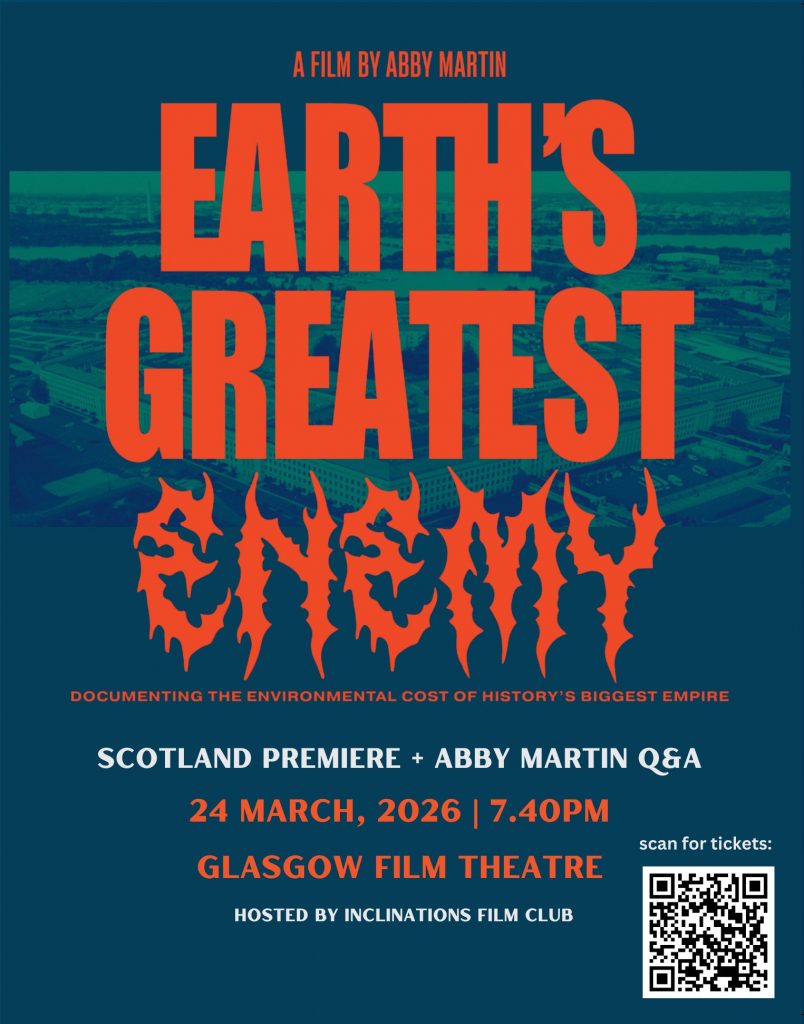
Earth’s Greatest Enemy
Director: Abby Martin, Mike Prysner
Cast: Abby Martin
I’ll be 80 this year – ‘Earth’s Greatest Enemy’ is the most disturbing and revealing documentary I have ever seen. The scale of environmental devastation being wrought globally by the U.S. Military is terrifying and incomprehensible.
In the documentary Abby Martin captures the tragedies taking place on a massive scale as a result of environmental damage and the effect of imperialism on the climate crisis – with the main offender being the U.S. Military.
As we ordinary people diligently separate our rubbish, switch our diets to more plant based foods and seek out biodegradable products in our attempt to tackle the climate crisis, simultaneously, unchecked destruction of the environment and its people is taking place on a monumental scale.

Abby Martin and Mike Prysner
The documentary meticulously examines the colossal damage of U.S. militarism, not only to the environment, our oceans and rivers but to the animals and to people. It reveals how the policy of extending a country’s power and influence through military force has severe implications for the planet.
As we see world leaders meet annually at the Conference of the Parties to the United Nations Framework Convention on Climate Change (COP) and nations agree to increase climate ambitions , accelerating global climate action, U.S. imperialist aims sees the establishment of military bases throughout the world – controlling 75% to 85% of all foreign military bases globally.
After taking office in January 2025, Donald Trump immediately started the process whereby the United States withdrew from the Paris Agreement, stating that it burdened the U.S. economy. Thus there is little requirement to report emissions. Alongside this failure to contribute with other nations to tackling climate change, the documentary reveals the U.S. military to be the world’s most prodigious and dangerous contributor to climate change.
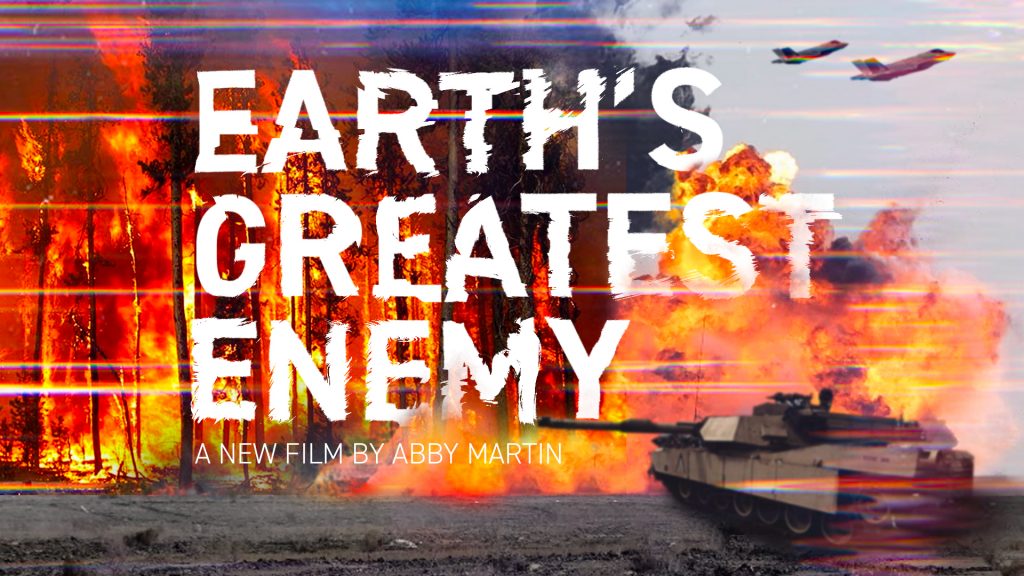
Abby Martin’s film highlights statistics showing the unimaginable scale of military generated pollution: one flight of a Boeing Pegasus emits more carbon dioxide than the average American driver will emit in 40 years. The U.S. has around 800 bases around the world, each with fleets of heavy vehicles; some 270,000 barrels of oil a day are used, adding about 55 million metric tons of CO2 to the atmosphere. This is what we know but is unlikely to be the full picture as record keeping is notoriously incomplete. Additionally within the US there are approximately 500 military bases.
One of the most callous and incomprehensible effects of the pollution by U.S. military bases is the impact on its own forces. The film points to a particularly horrific example at Camp Lejeune in North Carolina. where the consumption of contaminated water caused serious illness, birth defects and the death of many infants. One of the most harrowing scenes shows the cemetery in Jacksonville, where so many infants born to military wives are buried that it has been named Baby Heaven. Despite these tragedies the military covered up water contamination, allowing it to continue long after it was identified.

A reason given for military exemption from climate change aims relates to national security. However, the film shows that the effects of large scale military pollution are much more widespread than in war zones. The decimation of Gaza through Israel’s partnership with USA has been well documented and is viewed as ecocide with acts of war causing severe longterm damage to the environment. Such action is part of a strategy to destroy places where war is being waged and is a tool in the expansion of the US empire. Apart from the loss of life and infliction of environmental damage during wars the military, through unethical practices, leave behind long-lasting hazards. In an activity known as ‘Trashing’ the film captures images of unused arms being buried or destroyed leaving the land, rivers and streams contaminated. One serviceman explains that in order to be granted similar funding in future, any under use of weapons must be concealed. The documentary shows a disturbing scene of an enormous fire destroying left over weapons and ammunition as troops cheer the spectacle.
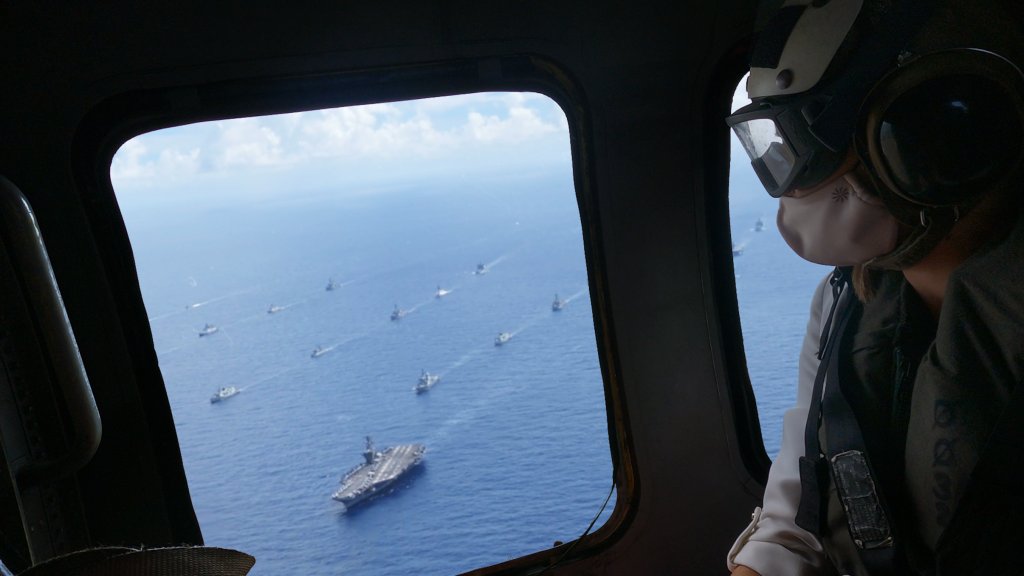
The reason for exclusion from climate change aims of national security is shown to be absurd with the large scale practices geared for attack. These appear to be much more about invasion than protection. The Rim of the Pacific Exercise (RIMPAC) – the world’s largest military exercise hosted biannually by US Navy in Hawaii – results in massive pollution of the ocean. It has damaging effects on biodiversity sustaining ocean life, livelihoods related to fishing plus widespread destruction of sea creatures.
A search on Google acknowledges impact on sealife as follows: “Environmental Concerns: Some local activists and environmental groups have historically opposed the exercises, citing potential risks to marine mammals (such as whales and dolphins) from sonar and underwater explosions.” This paints an exceedingly mild picture from the reality.
Sonar has a devastating effect as loud as 240 decibels, it can travel up to 300 miles. The volume leads to injury and death, affects mating and violates sea life.Ironically, as shown in the film, the U.S. navy places a ceiling on how many mammals they may kill. These are called TAKES and the numbers are not low: over 26,000,000 takes are permitted of sea mammals during the world’s largest maritime warfare exercise. Precise numbers are allocated to each species, for example, permitted number of seals that can be destroyed is 1,062,230 and sperm whales 931,068. The impact on sea life is catastrophic.
The strength of the message the film carries is caught particularly well with regard to the range of people interviewed which includes scientists, veterans and members of communities affected by U.S. Military activity and environmental pollution.
In Maryland one man became interested in the issue of contamination caused by the military when he became aware that the oysters he had caught and enjoyed locally for decades were full of toxins. His research found that every one of the 400 military sites he investigated was responsible for metal pollution with the additional issue of radiation.
Abby Martin explains that the U.S.’ Department of Defense ‘reports that it dumps 28,000,000 lbs of toxic waste annually’ . Unsurprisingly the effect on people living in those parts of the world where the U.S. military machine wrecks havoc has led to protests by activists. The documentary vividly captures demonstrations by local people in the Okinawa Islands in Japan, with over 70% of the presence and 26,000 US military. This unique subtropical environment characterized by its crystal-clear waters, vibrant coral reefs (hosting over 400 species) and including blue coral – designated with conservation status of vulnerable species by https://www.iucnredlist.org/ Is being destroyed by US military expansion. Despite overwhelming objection, to the settng up of a further U.S. military base, we see a mountain, raised to the ground and debris extracted dumped into the sea in ‘an exercise of our destruction’.
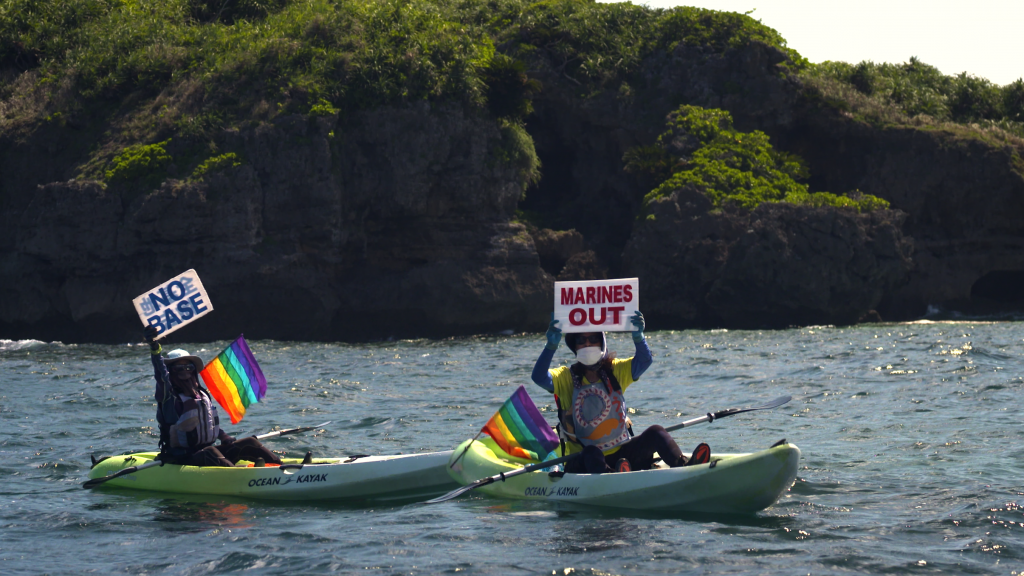
The U.S. military activity in Okinawa has seen local residents, environmental activists and local politicians, including the Government of Okinawa, raise overwhelming objectives to the environmental destruction and pollution of the area. But despite deforestation, water pollution and threats to vulnerable and endangered species such as the Okinawa dugong, listed in Schedule I of the Wild Life (Protection) Act, 1972, the U.S. military expansion continues without accountability. Unchecked the U.S.builds its military might in pursuit of imperialism and expansion of its capitalist empire. Where the acquisition of, and access to, the world’s rich resources such as oil and routes to transfer resources around the world is paramount.
The Danish have reported on similarities between Okinawa and Thule in Greenland, where “both have been marginalised from their central governments’ dealings with the American guests – albeit in significantly different ways.” (Okinawa and Thule US Military Bases
Recently Donald Trump has expressed interest in the U.S. acquiring Greenland, an area where climate change has led to greater opportunities to investigate the existence of resources such as oil.

The documentary makes a very significant contribution to the understanding of the implications for the planet regarding the recklessness of U.S. Military and its practices. This is not only in relation to active warfare and resultant long lasting hazards and destruction of people but regular activities at military bases. The global expansion of such bases is much less about security than it is about imperialism, acquisition of resources and the building of empire. Whilst contemptuously contributing to the climate crisis.
As Martin points out:“The fight against the war machine and the fight to save the planet is the same fight,”. . . “Linking these issues together gives us more strength.”
When people and governments’ eyes are opened to the Earth’s Greatest Enemy, forces should be joined to protect our planet and ourselves.
Pat Byrne, March, 2026
Try to catch this amazing film. It will be shown at Glasgow Film Theatre on 24 March.7.40p.m. This screening will be followed by an in-person Q&A with Abby, hosted by filmmaker, writer and programmer, Rastko Novaković.

Inclinations Film Club – Rastko Novakovic
This section: Cinema, Film reviews, Film Reviews, Pat's Home Page Blog
Filed under: Cinema, Film reviews, Film Reviews, Pat's Home Page Blog
Prevous page or post | Next page or post
Written by : Pat Byrne

Related Pages
- Children’s Walk for Gaza, Glasgow Green
- Black History Month 2026 at GFT
- Soul Jazz Sunday September Weekend 2026
- Glasgow Americana: Dar Williams & Heather Maloney at Cottiers
- Niall Connolly and The Album Club at The Glad Cafe review Pat Byrne
- Carmunnock Village Glasgow Doors Open Days 2026
- Line Dancing In St Mungo Square
- The Cycle of Love at GFT
- Queen At Sea at GFT
- Pressure at GFT
- Take 2: The Wizard of Oz
- Bad Apples at GFT
- Woodlands Anti-Racist Film Club – Everybody to Kenmure Street
- Scottish Queer International Film Festival 2026
- Borscht Film Club: Polish Comedy Shorts & Q & A
- The Album Club, Niall Connolly at The Glad Cafe
- BFI London Film Festival 2026 at GFT
- Samizdat Eastern European Film Festival at GFT
- La Femme Infidèle at GFT
- Take 2: The Rugrats Movie at GFT