Wully Davidson: Climate Change – Glacial Lake Outflow Floods & Glacier Collapse Floods
Glacial Lake Outflow Floods (GLOFs)
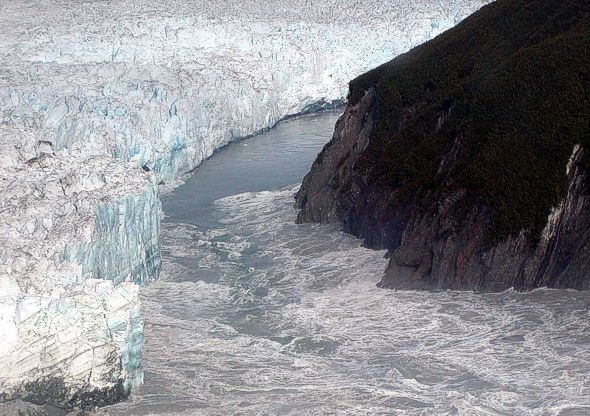
A glacial lake is a body of water in a high mounain valley, held in place by a glacial dam, which can be made of ice, glacial moraine (rocks deposited by the glacier), or a mixture of both. If the volume of water in the lake increases due to increased meltwater from glaciers, or increased rainfall, due to global warming, this exerts increased pressure on the glacial dam. If the ice in the dam also begins to melt due to higher temperatures, it will weaken, and perhaps collapse, leading to a catastrophic release of the lake water and flooding downstream.
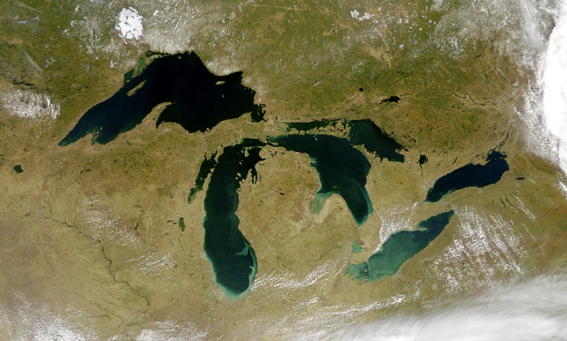
The Great Lakes of North America from space. SeaWiFS Project, NASA/Goddard Space Flight Center, and ORBIMAGE., Public domain, via Wikimedia Commons
Globally, about 15 million people live in areas that could be affected by GLOFs, across thousands of glacial lake sites. The Himalayas and other areas in Asia are most susceptible to these disasters. Studies have identified thousands of lakes, including 2,211 high risk lakes, putting roughly 9.3 million people in danger. More than half of all people at risk globally, live in just four countries – India, Pakistan, China and Peru.
The annual average of glacial lake outbursts has risen from about 5.2 events in 1981-90, to 15.2 in 2011-20. This is associated with rising global temperatures, which are causing glaciers to melt, glacial lakes to expand, and making the natural dams more unstable. More intense rainfall also accelerates glacier melting, and the intensity of south Asian monsoon rains has increased in recent years.
Although such an event is caused by a buildup of these forces, it is often triggered by a displacement wave, which may be caused by collapsing glaciers, rockfalls or snow avalanches plunging into the lake. These waves can overtop the dam, causing a flash flood downstream, but they can also breach the dam, causing much more severe flooding. So, some GLOFs may be preceded by an earthquake. Many moraine dams have a hidden ice core, which can melt due to increased water seepage and pressure.
Glacier Collapse Floods
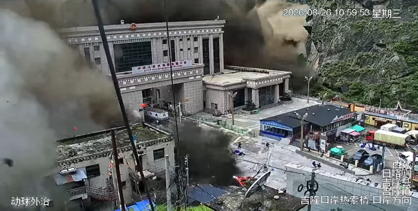
Mudslide at Gyirong https://commons.wikimedia.org/wiki/File:
Nepal/Tibet Flood August 2026
The recent Nepal/Tibet flood appears not to have been due to a GLOF, but to a 0.2 square km piece of ice dropping vertically for about 0.75 miles. The kinetic energy of the fall melted the ice, and the resulting flash flood carried a huge amount of rocky debris along with it. Glacier collapse floods are less frequent in the region than GLOFs, but can be much more devastating. It’s believed to have had a volume of between 100 and 200 million cubic metres, and wiped out communities as high as 270 ft (80 m) above normal river levels.
By contrast, a 1929 GLOF in Pakistan is believed to have released some 1.35 billion cubic metres of water, or roughly 10 times as much than the recent Nepal/Tibet flood. There’s little information about casualty figures for the 1929 flood, but it may have been less destructive than the recent flood, as debris reached just 85 feet above normal. The reason is that in the recent flood, the water was released instantaneously, while the glacial lake in the 1929 flood would have taken time to drain.
Initially, it was thought that an earthquake had caused the collapse of the glacier, but it’s now believed that it was the collapse that caused the seismometer readings. Current theory is that the bottom of the glacier, which had been acting as a buttress, gave way under the weight of ice above it. Glaciers melt from the bottom up, so most of the melting occurs at the lower altitude. If so, this may not be the last such event as the world warms, but there’s no way of telling how many glaciers are similarly primed to collapse. It’s an unknown, like many other aspects of global warming.
Past events
1941 – Huaraz, Peru, A GLOF destroyed a third of the city of Huaraz, killing an estimated 5,000 people.
1962 – Ranrahirca, Peru. A colossal block of ice broke off, causing 10 million cubic metres of rock, ice and snow to slide down the mountain, killing an estimated 4,000.
!970 – Yungay, Peru. A magnitude 7.9 earthquake caused a mass of glacial ice and rock to bury the towns of Ranrahirca and Yungay. Total deaths were around 50,000, half of them attributable to the avalanche.
2013 – North India floods. Unusually early and torrential multiday monsoon rainfall, melted snow and ice and rapidly raised the level of Chorabari lake, causing its ice/moraine dam to burst and send a torrent downstream. It’s unclear how much of the flash flooding was due to the dam collapsing, and how much simply due to the rain and melted snow pouring down the valley sides. There were 6,054 deaths recorded.
Wully Davidson, August, 2026
This section: Pat's Home Page Blog, Science: Climate Change and Other Topics
Filed under: Pat's Home Page Blog, Science: Climate Change and Other Topics
Prevous page or post | Next page or post
Written by : Pat Byrne

Related Pages
- Phantasmagasm Halloween at The Glad Cafe
- The Dark Side Walking Tour
- French Film Festival 2026 at GFT
- Agatha Christie Exhibition – The Mitchell Library
- Scottish Writers Centre Spookeasy The Griffin
- Aye Write Presents – Chris Carter, Hide and Seek
- Children’s Walk for Gaza, Glasgow Green
- Steal This Story Please at GFT
- NAZA at GFT
- Hallowe’en Market Glasgow
- Scottish Mental Health Arts Festival 2026
- Open Casting Workshop, A Play, A Pie and A Pint
- The Jackie Marno-McGoldrick Art Prize and Exhibition 2026
- Scotland Loves Anime at GFT November 2026
- The Prime of Miss Jean Brodie – Citizens Theatre
- The Littlest Yak – Paisley Arts Centre
- Wullie Davidson Climate Change: ‘Godzilla’ El Nino Brewing
- Scotland’s first Stained Glass museum to be opened in lasting tribute to the works of Alf Webster
- Unveiling Nelson Mandela Statue in Glasgow
- Greg Koch at Cottiers