
Unlocking Maryhill – A history of its places and people by I.R. Mitchell
Glasgow’s Venice
 If the Dear Green Place has a Venice then it has to be Maryhill. Such a designation will surprise the hordes of commuters from Milngavie who rush the three miles down Maryhill Road to Central Glasgow each day, leaving nothing behind but the pollution from their cars for the local weans to inhale. These carbound souls have possibly never set foot on terra firma between Canniesburn Toll and St George’s Cross, the beginning and the end of Maryhill Road. But they are the losers.
Anyone with a bit of knowledge of Maryhill will probably be aware that I am suggesting that its position astride the nub of Central Scotland’s canal system, where the Forth and Clyde joins the route to Port Dundas in Glasgow, renders Maryhill the Scottish Venice. It also has its Maryhill Fleet – as its conglomeration of boats at Maryhill Dock was affectionately known – as a rival to the maritime might of the former Doges of Venice. (Ironically, as Maryhill and its industry declined, the term Maryhill Fleet was taken over by one of the gangs which briefly flourished in the area.)
The Glass Industry
But a minimum of two pieces of evidence is required to make a case, and Maryhill has at least such in that. Like Venice, it was also the centre of the glass industry. Indeed Murano Street, overlooking a canal as important as any in Venice, was named after the Italian city?s main glass manufactory.
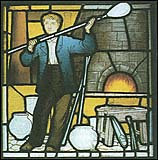 In addition Maryhill was the location of one of the most unusual and interesting collections of stained glass in Scotland (infra). And then, like Venice with its St Marks, Maryhill had a cathedral. For a while after the Disruption of 1843, the Free Kirkers met in a canalside sawmill at Kelvin Dock with planks for pews, and the place was dubbed “Maryhill Cathedral”. I rest my case.
The Kelvin Aqueduct
Until the Forth and Clyde canal came along, there was very little thereabouts apart from the rural estates of several leading Glasgow families – and some light industry such as paper making along the River Kelvin. But the Kelvin was soon superseded by the canal, the triumph of the latter symbolised by the mighty Kelvin Aqueduct built from 1787-90 which carried the canal haughtily over the river on four heavy masonry arches. The Kelvin’s water powered mills were also superseded by the clatter of steam engines as industries
migrated to the banks of the new waterway.
The Kelvin Aqueduct was a wonder of the world, the mightiest built possibly since Roman Times, and tourists flocked to see it, including crowned heads of Europe. It was the technical key to the Forth and Clyde Canal, itself the artery of the first phase of Scotland’s Industrial Revolution. The engineer in charge of its construction was Robert Whitworth, and the cost of the structure, at 8500, almost bankrupted the company building the canal.
Scheduled as an Ancient Monument, were this structure in some rural retreat it would be visited by thousands; I doubt if more than a handful of the curious come to see it today. But this may change with the recent re-opening of the Forth and Clyde Canal, and the aqueduct could again become a major tourist attraction.
The Botany
Maryhill was a wild place in the early years of the industrial revolution, and an area of the town consisting of lodging houses and public houses was known as The Botany, (Butney in local parlance and today commemorated in a greasy spoon joint called The Butney Bite). This area was possibly so-called as it produced so many souls who were destined for transportation to Botany Bay.
The formation of the first Temperance Society in the world in Maryhill in 1824 by John unlop apparently did little to curb excessive drinking (it was a fairly lenient organisation in that it pledged abstinence from spirits, but allowed beer and wine.) The nature of the work in constructing the canals, and then the railways, and the later still the water works to Glasgow from Loch Katrine though the area, meant that large numbers of navvies were drawn to Maryhill. When these overrefreshed themselves, the local Irish priest would enter the hostelries with a shileileigh, and beat about his compatriots until they left the pub. This was dramatic, but insufficient law enforcement, and when Glasgow refused to supply a couple of policemen, locals felt they had to act, and police powers were sought – often the main motive for acquiring burgh status. These were attained in 1856 and the town took its name from combining the forename and surname of a wife of the proprietor of a local estate.
 These police powers may have helped clean up the town of undesirable aliens, but new dangers soon arose, from within Maryhill, and Glasgow itself. The City Council condemned the:
“inadequate provision now made for the preservation of the Public Peace in this City on those occasions of Riot and Tumult, which too frequently occur in the manufacturing and populous districts, from a temporary stagnation in trade and want of employment of the working
classes.”
Despite the fact that Maryhill was an independent burgh, it agreed to the erection of Glasgow’s new barracks, which were moved to Maryhill from the East End. The greatly enlarged complex was opened in 1876.
Mainly locally recruited, and the base of the Highland Light Infantry from 1920, the soldiers at Maryhill Barracks were deemed to be unreliable during the 1919 40-hours general strike in Glasgow, and were confined to barracks while troops from elsewhere were brought in to re-impose order. The barracks gave Maryhill the air of a military town; there was a Soldiers? Hotel where those on leave could entertain relatives, and military pubs such as the HLI (now gone) and the Elephant and Bugle (the HLI emblem). Much of the wall of the barracks remains, as does the gatehouse, which gives entry to the Wyndford housing estate which replaced it.
The Barracks may not be the Venice Arsenale, but the locals were so attached to the gatehouse that they prevented plans to demolish it. The Soldiers Hotel became the Maryhill Trades Union centre for a while and boasts a mural of the whipping of the leader of the 1797 Weavers Strike through Glasgow. But Maryhill has its own working class martyr.
In 1834 there was a strike in the calico printing works. The printers replied to the introduction of blackleg labour by sabotage, destroying their work by tearing it or pouring dye on it. The mill manager was entering the works one day when a pile of bricks and a window frame fell near him. They “maun jist hae tumbl’t oot themsel’s,” said the strikers. Arrests were made, some workers jailed and troops from Glasgow Barracks were quartered in the works, where the scabs lived and ate for the duration of the strike. The authorities were then faced with the murder of a striker in The Butney by “Clay Davie” a nab or nob. The police investigation was carried out, but the murderer was discharged. The Calico Printers’ Union erected a memorial to the worker in Maryhill Churchyard, an iron pillar with a brass inscription,
“TO THE MEMORY OF GEORGE MILLAR, who was mortally wounded at the age on
Nineteen on the 24th February 1834, by one of those put to the Calico
Printing Trade for the purpose of destroying a Union of the regular
workmen, formed to protect their wages. THIS MONUMENT WAS ERECTED BY HIS FELLOW OPERATIVES.
Maryhill Burgh Halls
Many of the graves in the churchyard were desecrated by the over
enthusiastic demolition squad, who flattened them into the general rubble when the church itself was demolished, and I have failed to locate Millar’s grave. These rubbled ruins lie opposite the Butney. But if Millar has no surviving commemoration, many of Maryhill’s other workers do, or did, within the Maryhill Burgh Halls.
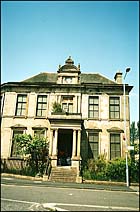
Two years after the barracks opened, so did the Municipal Burgh Halls, designed in a revivalist French Renaissance style by Duncan McNaughtan. Maryhill has not the richness of public buildings that areas like Govan or Brigton possess, so it is fitting that its municipal buildings are amongst the finest of all the burghs’ absorbed by Glasgow. Or were the finest, for shortly after celebrating the centenary of Maryhill’s annexation by Glasgow, the halls were closed. So too was the swimming pool whose marvellous exterior, stretching back from the Burgh Halls, gives some idea of its former grandeur.
 Adam’s Stained Glass Panels
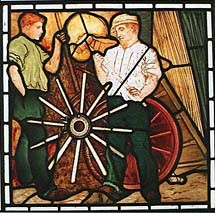
The crowning glory of the Burgh Halls was a series of twenty stained glass windows made by the Glasgow firm of Stephen Adam. These windows commemorate the industries of Maryhill, and the men and women who worked in them. This in turn gives us the key to Maryhill, its industrial diversity. Govan was ships, Springburn was locomotives, Brigton was textiles followed by heavy engineering, but Maryhill had a varied industrial base, recorded in these windows. One of the panels, appropriately enough, commemorates the skills of the glassblower. Another, showing workers in the chemical industry, can be seen in the Glasgow People’s Palace. The rest are in the care of the City Council, and depict blacksmiths, carpenters, a gasworker, engineers and many other occupations. This is a unique collection of world historic significance, on a par with Maryhill’s other great asset, the Kelvin Aqueduct.
Despite its character as a working class city, public art in Glasgow largely ignored labour as a theme. Where it is recorded, labour is most often represented by classical maidens as at the Stock Exchange, or by medievalised workers on the City Chambers, or even by cherubim operating machinery. Adam’s Maryhill stained glass panels are a dramatic exception, but there are others. MacGillivray’s shipyard workers outside the Govan yard and Lavery’s mural of shipyard workers inside the City Chambers spring to mind. (see Glories of
Govan chapter.)
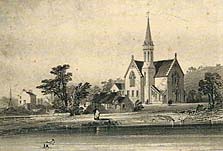 The swimming baths have been long closed, so any of the folk of Maryhill desirous of a swim (and not fancying the canal) must find their way to Scotstoun, several miles away. [Swimming Pool and Sports Centre reopened at Maryhill Burgh Halls in 2012]
There are no other public sports facilities in Maryhill, none. Donna Brooks, of Glasgow City Council Development and Regeneration Services, told me,
“Plans for redevelopment are still not final, but it is hoped that the swimming pool could be the site of a new sports centre, while the Burgh Hall could be put to a variety of community and commercial uses.”
Donna sees the canal as becoming a focus for Glasgow’s redevelopment, as the River Clyde has already become, though canal developments would be on a more local scale. Housing, sports and arts facilities, as well as marinas for boats and even a hotel are being mooted for the various brown land sites along its banks.
The baths have gone, and the closure of works like Bryant and May, which provided sports facilities (including a quoits pitch) for their workers has further encouraged a sedentary lifestyle. But some try. The Maryhill Juniors engage in a sport bearing some resemblance to football, and have produced such greats as Danny McGrain from their ranks – though the last time they won the Junior Cup was in 1940. The Maryhill Harriers still operate, and though like the Juniors their great days are in the past, they have produced three Olympic competitors, and a marathon gold medallist at the first Empire Games in 1930, “Dunkie” Wright. The most popular sport amongst the locals would appear to be fishing in the canal. I asked one if he ever caught anything and whether it was fit to eat. “Oh aye”, he said, “Ah get a lot o pike. Bit ah never eat it, Ah hate fish.”
In his interesting little book Memories of Maryhill, Roderick Williamson tells of his interwar childhood, growing up in Braeside Street, amongst the respectable working classes, adding that gangs, violence and criminality were markedly absent from this area of No Mean City – as was sectarianism. Many of the local men were skilled tradesmen with the council, and Wilkinson’s father was unique in being an often-unemployed shipwright – and fervent Communist. This was the most respectable part of Maryhill, at the very edge of the historical burgh and bordering on posh North Kelvinside. Jock Nimlin, the greatest of the Glasgow working class mountaineers also came from hereabouts. His family were Finnish immigrants, Methodists and ILP members, and Jock worked in the shipyards for many years, before writing and radio work led to a job with the National Trust.
 Mackintosh’s Queen’s Cross Church
Lets start here, for just across Maryhill
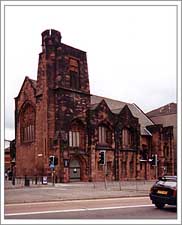
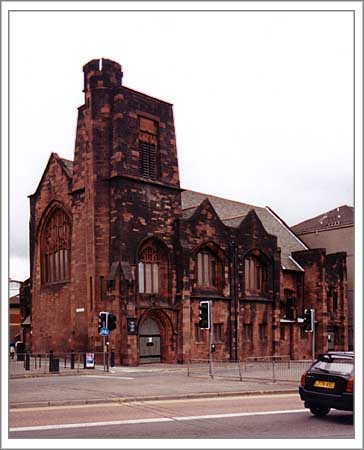
Road, is Charles Rennie Mackintosh’s Queens Cross Church, built in 1899 and the only church Mackintosh designed that was ever built. Today it is the headquarters of the Mackintosh Society, and is open to visitors at certain times. As you proceed northwards up Maryhill Road you can understand why churches like Queen’s Cross were closed, for between here and the junction with Queen Margaret Drive, much of the original housing has been demolished, to be replaced by “landscaped” areas. Signs are however that living beside the canal is now being seen as a plus, and there are plans to build apartments alongside its banks. From here to Ruchill Street, Maryhill Road retains its original unbroken tenement line, and Ruchill Street itself has a Mackintosh connection, in that the Church Halls, where you can drop in for a cup of tea and a keek, are his work – though not the church itself.
Further up the road we are in the heart of present-day Maryhill, with the site of the barracks on the left. Their wall is now overtowered by the multi-storey flats which replaced it, and just a little further on is the Burgh Hall itself, sadly cut off from the community by the closure of Garbraid Avenue, and of course, the Hall’s own closure. The main other building of note hereabouts is the public library on the right side of Maryhill Road, built in 1905, as were so many others in Glasgow, with help from Alexander Carnegie. It has fine sculptures and a separate entrance for Boys and Girls. Passing under an aqueduct which carries the canal over the road you come to the part of Maryhill most associated with the waterway.
Maryhill Docks
On the left are soon seen Maryhill docks, locks and dry dock – with the associated Kelvin Aquedect- one of the biggest complex of canal
construction associated with the entire feat of engineering a canal across Scotland. Still standing too is The White House, a pub dating from the days of canal construction. However a canalbank hotel built for those using the waterway, which had a 24 hour licence to deal with the constant canal traffic, has gone. The reopening of the canal will hopefully be a focus for the regeneration of the whole area around Maryhill Locks, whose condition is a far cry from that around Queen’s Cross where we started. The White House in particular, a graffiti-sprayed eyesore, only needs restoration to re-emerge as a cameo to grace the canalbank.
Barge cruises on the canal
On 26 May 2001 a fleet of 40 vessels sailed from Falkirk to Bowling, ceremonially reopening the canal. Now holiday operators are offering barge cruises from Glasgow to Falkirk-or all the way to Edinburgh. This is a revival of the use the folk of Maryhill put the canal to. Their Doon the Watter was a cruise, in boats like the Gypsy Queen which ran from 1905 to 1940, along the canal to Kilsyth or further, with jazz bands playing. Until the closure of the canal in 1962 the weans of Maryhill would help the yachtsmen and fishermen who latterly frequented it, to open the various lock gates, and as reward hitch a lift as far as Clydebank or even Bowling. It is unlikely however, that any hitched a lift on the midget submarine which
negotiated the canal in 1952.
Maryhill Dock is a good point to transfer from Maryhill Road to the canal banks, and retrace steps south, ending up almost where we started. Landscaped, cleaned up and devoted to leisure pursuits, the canal still shows the evidence of its past as the industrial artery of Scotland, and of Maryhill in particular. The economic life of the burgh was so varied that pointing out a few of the more prominent factories, or their remains, is the best policy. The locks at Maryhill had a dock-slipway, still visible, where boat building took place from 1857-1921. The firm of Swan built many of the famous Clyde “Puffers”, the iron hulled and steam propellor driven vessels which plied the canal and the Firth of Clyde, including the very first one, the Glasgow. The dock is still commemorated in a pub opposite (its tenement gone), called The Kelvin Dock. Swan, who became the first Provost of Maryhill, recruited many of his skilled men from amongst Falkirk’s ironworkers. As the canal snakes towards Glasgow, the main branch heads from the Stockingfield Junction towards Falkirk. A confused jumble of buildings now occupies the ground of the former Kelvin Chemical Works, behind which lies the stadium if that is not too grand a statement, of Maryhill F.C. As you proceed on your right there is a culvert leading water from the canal to the site of the former works.
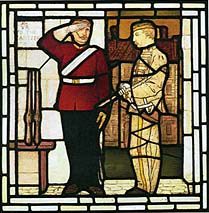 On the left now appears the former Bryant and May factory, which produced Scottish Bluebell matches until 1981, and which itself was formerly Alexander Fergusson’s Lead and Colour Works. This handsome building, now fronted by a rather faded mural about the delights of the canal, has been converted to non-industrial use. Passing the bascule bridge over the canal at Ruchill Street, you have Mackintosh’s Ruchill Halls in view again on the right, while on the left is the site of what was Maryhill’s largest industrial undertaking, McLellans Rubber Works, dating from 1876. With the remains of its own canalside wharfs, and working till a few years ago, the factory is now
rubble and ruins, and being redeveloped for housing. The canal bends, and soon, on the opposite side where now only coots and swans survey the doings of the coarse anglers by the canal banks, are the sites of the two Maryhill glass factories, the Caledonia Works producing bottles and jars, and the Glasgow Works manufacturing plate glass. Much of this land is now taken up by Glasgow University student village. Though Murano Street overlooks the glassworks no more, the canalside here still hosts an active industrial unit in McGhee’s Bakery, on the site of the former Firhill Sawmills. The underpassing of the delighfully restored Nolly Brig brings you to Firhill Basin.
On the other side of the canal, within the Ruchill section of the former burgh, are more remains of Maryhill’s industrial past. The ironworks of Shaw and MacInnes survived miraculously until the year 2000, and next to that also on the canal, were found the Phoenix chemical works, alas not rising from the ashes, like the mythical bird they were named after. Both works long used the Firhill Basin to transport their products from Maryhill to market. Shaw and
MacInnes had originally, like the Swans at Kelvindock, brought their
skilled ironworkers from Falkirk; appropriately they came by the canal.
One can take a short walk up to Ruchill Park for a fine view of the city, from its high point, created by building a mini mountain from the rubble left after the construction of Ruchill Hospital. This, formerly the highest point in Glasgow, used be known as “Ben” Whitton, after the then Director of Parks. Or simply head back down to Queens Cross Church and our starting point at Burnside Street. By now you will have a good idea of where the inspiration for those stained glass windows in the Burgh Hall came from. And will understand how the Forth and Clyde Canal gave birth to Maryhill. Hopefully in its new-found role as a tourist, wildlife and recreation corridor, the waterway will make a contribution towards Maryhill’s regeneration – though the industries of the papermaker, glassblower, chemical worker and all the others have disappeared forever from the canal banks.
Copyright I.R. Mitchell
Ian R Mitchell, the author of Unlocking Maryhill, is so gratified by the response to the article, that he has written a further contribution which will be of interest and encouragement to all those who have written in so far. (October, 2007)
Maryhill Burgh Halls Restoration – Ian R. Mitchell
Bigman: Celebrating new sculpture at Maryhill by Andy Scott – October, 2008.
THE MEN OF LYON STREET; REQUEST FOR INFORMATION
I am looking for information as to the possible current location of a memorial plaque which use to be on the walls on the long vanished Garscube Bar in Garscube Road. This commemorated The Men of Lyon Street, a street off Garscube Road, who fought in World war One. Over 200 men from this street volunteered for the war and Lyon Street became famous as the most decorated street in Britain.Since the demolition of the pub in 1962, the location of the plaque has been lost. Anyone with information should contact me, stobx@btinternet.com
See also: Maryhill Burgh Halls, Gordon Barr,May, 2010
Archived comments
When we moved this page to our new content management system we could not bring over the comments. The comments are archived on this page.
Ian R Mitchell, the author of Unlocking Maryhill, is so gratified by the response to the article, that he has written a further contribution which will be of interest and encouragement to all those who have written in so far. (October, 2007)
Maryhill Burgh Halls Restoration – Ian R. Mitchell
This section: maryhill, Writing
Prevous page or post | Next page or post
Written by : Jim Byrne

Does anyone know Bobby(Robert)Johnson? He served in the Merchant Marines as a cook in 1964. He lived in Glasgow when he wasn’t at sea (usually six months at a time). I would like to know what happened to him after I immigrated to Canada in 1964. If you know him or of him please leave a comment. Thanks.
I am looking for information on Elaine Black Anderson. She married Richard Anderson who was my co-worker at John Bruce and Company on Bothwell Street. I lost touch with her through the years and would to re-connect with her. If you have any information I would appreciate if you would leave a comment. Many thanks.
Hi, I am looking for any information anyone has about an orphanage on or near Lyon street. My grandfather was from there and used to mention Lyon street. Robert McEwan was his name. Myself and my mother are looking for any information anyone has, even if it’s just pointing in the right direction
Looking for relatives of Alice guess who married James John Kennedy , James is my relative and would like info on him , James father was also James Kennedy who was the trainer for partick thistle , can any one help
I am looking for a a few friends of mine who both lived in the Maryhill area of Glasgow ,we all worked in Scarborough together in the early 70 s, there names were Jacqueline Marshall , who loved with her family at 2 Shannon st ,and my other friend Moira Monaghan I can’t think of the adress for my a ,but not far from Jackie,I think it was the next stop up from Shannon st and I think up hill from there ,I would b grateful for any information
Hi, Moira now lives in Canada. Sadly Jacqueline died a few years ago at the age of fifty. I used to live in Shannon St.and knew both of them.
hey Pat just got a message from Ronnie Docherty
that my name was being mentioned on this site.
I am still in Toronto. how are you?
hey Jean, Moira here I am in Toronto since 1974
alive and well getting ready to retire.
Hi I’m looking for any information on mothers uncle mr Joseph McCormick wh ran a fish n chip shop in Glasgow probs would be in town centre but not sure also her father James McCormick who died in 1987 aged 67 any info would be appreciated
Hi
I am looking for any information, memories and/or photos of the former canal slipway which is just off Sandbank Crescent, before the aqueduct. Many thanks.
Hi Alan, You might be able to get some information from Scottish Canals: https://www.scottishcanals.co.uk/
I am looking for Maryhill FC E-Mail Address.
https://www.clubwebsite.co.uk/maryhillfootballclub/301074/
The club received national news attention in April 2017 when Gavin Stokes scored one of the fastest recorded goals in world football in a home fixture against Clydebank, with his drive into the top corner from the halfway line timed at 3.2 seconds.
Hello,
I’m looking for some information around a death of a 4 year old girl named Janet Smith who was abducted (and murdered) from her home, 271 wilton st on the 06/01/1962.
Any information would be great
Thanks.
I Believe this was [ not sure ]this was the first person in Scotland to be charge with murder with out a body,the little girls body was later recovered from the river Kelvin. In 1961 the person convicted of this murder worked at that time with a company called McKenzie partners on Lochburn road Cadder along side the canal there head office as far as i can remember was in Castle street Toonheid [ they were concrete fabricator ] all i can remember of him [ not even his name ]he was a small timid inoffensive man he only worked there two or three weeks whilst there prior to Christmas he got charged with breach of the peace he could not afford bail if you new Glasgow people no way could you let a work mate be locked up over neerdy can’t remember how many of us there was being conservative may-be ten any way we put the hat round ten bob each and put up his bail
to this day i have not put up bail for any one unless i have personally known them for years [ in my thoughts over the years if only]I knew the little girls dad not many left who worked there i am now 77.
Jim formally Rolland street Maryhill been 47 years in South Ausralia
Hi I saw your message about looking for information on Janet Smith(4) from maryhill ? I’m most certain we are both looking for the same info. My name is Sammy. Janet is my mum’s sister, my mum’s name is Yvonne?.
Scott Houston posted a message in August, 2014 asking if anyone knew his mother. I knew her and The Gillies’s who, I believe, were related. If Scott sees this, please repost and I’ll reply
Looking for margaret barry her brothers name tam barry both went to garrioch high school maryhill she married jack cooper believe now divorced he worked or works on double decker bus as driver had three children margaret would be about 64. Her brother now resides in america past 38 years.
I am looking for info and pics of my granddads ( Alan Marshall) scrap yard behind Kilmun St and Duart St in the 1960’s also stables in Kilmun St.
hi that was my dads cousins scrap yard my dads called tommy marshall mathews and allans cousin ive asked my mum and we dont have any pics am old tommy marshalls sons son my email is scottmarshall333@hotmail.com
HI , I,M LOOKING FOR ANYONE WHO REMEMBERS THE HEPBURNS AND GORMLEY FAMILIES FROM ROLLAND ST. I AM A HEPBURN AND THE GORMLEY WERE COUSINS . WE LEFT ROLLAND ST IN 1959 AND LOST TOUCH .
Hi,
Stumbled across a post in the archived comments from someone called Julie who was looking to get in touch with my dad – Robert Lynass.
We’re curious now! Get in touch if you happen to see this.
Thanks 🙂
Hi, My step mums parents used to run the sub post office in Viewmount Drive, Gilshochill, Maryhill. Billy Connolly lived in the flat above the shop. Both parents have recently passed away and we are trying to track down a photo of the post office. Been searching the net with no luck. Any help would be appreciated.
Try here
http://www.mitchelllibrary.org/virtualmitchell/
Hello is there anyone out there that can help find my granny Annie Gibb who rushed into a burning tenement in Ceder St maryhill 1934 She saved all three children believe there surname was Watson.Also the daily record took a picture of the children and it was on the front page.
Does anyone have any information on Alexander Taylor or his relatives he was a scaffolder in maryhill in the 1960s
Does anyone have info on Thomas Connolly, sons were Thomas, John, James and Tony daughters were Anne Mary Cathie and Agnes.
Hi I lived in Mary hill from 1963-1972 I went to st Charles school my best friend was Ann Margaret Scott.Did anyone know my parents Annie & Francis Cassidy or my grandad peter Milligan we lived in Rolland Street.
I am anne wylie from gilhill st, my brother is gordon, someone is looking for my family ?
Hello Lily, Billy Gormley here. Your dad (Andy) and mine (Bill) were cousins so that makes us second cousins I think. I haven’t seen you since the mid/late fifties after we moved to Drumchapel. I often wonder about my dad’s side of the family as he didn’t really talk much about them and I’m sorry to say I didn’t ask the questions. Do you know much of the history? I hope everything is well with you
All the best Billy