






More of Issi's West End Adventures
Monday 20 Apr 2009
Trees for Life Work Week 2009
This year our "Trees for Life work week" found us based at Attadale in the far north of Scotland near Lochcarron in Wester Ross. On reporting of this adventure the first thing that I have to mention is the weather. There was snow, hail and sleet, then sleet, snow and hail accompanied by gail force winds for a week!! You think that I am exaggerating well have a look at the photos.
Fortunately, the accommodation was first class, lovely clean well appointed cottages, open fires plus our bed linen and towels. It's the nearest to luxury for TFL and thanks to our fire lighting skills we were always warm and cosy.
 The Cottages are in the grounds of Attadale House which is quite an isolated spot. Once you arrive, there are no shops for miles, so a tip is to stock up with a good supply of wine (or beer or strong drink if you prefer), chocolate and crisps, or whatever other treats required when you arrive in Inverness.
Attadale House and the surrounding area has a lot to offer. It has gardens which are open to the Public and offer a good range of features such as a Japanese Garden, Kitchen garden and water garden. Majestic Stags and deer roam around the grounds and are pretty tame.
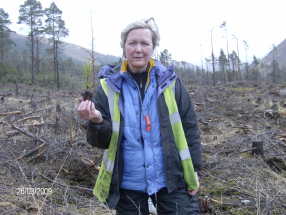
I really enjoyed the planting sites we were working at this year. One was high up on a mountainside at upper Glen Carron. As its location is against the prevailing wind there is little chance of the Scot's Pine self seeding therefore we were there to help Mother Nature along. Between this site and another one lower down we planted 3510 baby Scots Pine. Not bad for eleven of us. (Chris from the Forestry Commission also helped out a fair bit!) One of our volunteers this year, Sam, came from Norfolk and he just stood on the hillside on the first day staring. On asking him if he was okay he replied that he had never seen a mountain before. Well if you have never seen a mountain then that was the place to see them - looking over to the Torridon Range. The mountains (Liathach, Beinn Alligin, Sgorr Ruadh and Beinn Eighe) are some of the highest in Britain, rising in places almost vertically to 3500 feet from the deep sea lochs. Many visitors to the area remark upon the unusual atmosphere - it is truly one of the world's rarest and special places. The next day when we were out at the site the mist was so far down the hill you would not even know the Mountains were there!
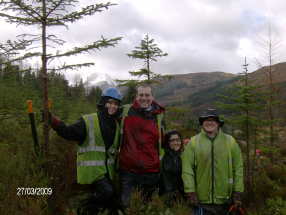 This year I planted a baby Scots Pine tree especially to celebrate the birth of my new wee Great Nephew - Rudy, the first grandchild on our side of the family. Replanting the Great Forest of Caledon is for his future. (I, of course, planted trees again for my girls and all my family and friends).
Our other task of the week was tree felling. Again another task I really enjoy. Thanks to Simon, this year I learned how to improve my sawing skills, (a life skill I really need) and was able to saw down a few big "baddie trees". Sounds weird doesn't it that we were felling trees in a tree restoration project, however the trees that we were removing were Sitka Spruce, Lodgepole pine etc - "Baddie Trees" which are non-native species of trees which grow at double the rate and crowd out the Scots Pine and other native trees such as Hazel and Birch. Here we cleared a site the size of one and a half football pitches. When were driving away from the site in the minibus we could all really see the difference that we had made.
As usual the food was fab during the week. This year there was more "choppers" than "cooks" and I seemed to be in the kitchen getting the dinner organised on a good few nights. It was a great way of getting to know each other better. A major theme of the week was cake!! One member of our team Lena, was an outstanding cake maker and even took on the challenge of baking a vegan cake. The creation was christened "Bananarama".
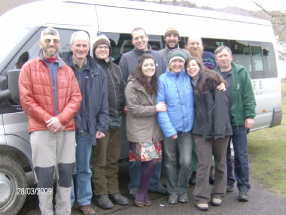 The only day we got anything like nice weather was on the Wednesday- fortunately our day off! We met up with our old friends Ann and Alan MacDonald and set off to Applecross for the day. I had never been over the Bealach na Ba, (Pass of the Cattle), which crosses the peninsula and reaches a maximum height of 2053 ft (626 m), below the 774 m high Sgurr a' Chaorachain, so it was quite a treat. I always remember my Mum telling me how scared she was on the road with my Dad on one of their trips to the Highlands "Jimmy you will need to get a helicopter to get me out of here". The views from the top were amazing and we could see all the way to the Outer Hebrides and Dunn Can on Rassay. We had fantastic bar lunch in the Applecross Inn and a walk along the shore to Toscaig to see all the wee houses before heading home.
We had a wonderful week, in spite of some quite challenging weather and as usual met some lovely people. "Hi to you all". We finished off the week with a coffee with other old friends Jim and Susan Piper in Inverness before heading (by train as we got cheap tickets this year I refuse to mention why) back to Glasgow.
At our last evening meal together Simon recited this poem and as we were all confirmed "tree huggers" by that time, thought was fab!! Hope you do too.
PRAYER FOR THE GREAT TURNING
May the turning of the Earth save us.
May the turning of the seasons & the turning of the leaves save us.
May we be saved by the worms, the beetles & the microbes turning the soil.
May we be saved by the turning of vegetation into compost
& the turning of compost into rich soil.
May the turning of seeds into plants & the turning of flowers
into fruits save us.
May the grasses & weeds, the vines & mosses all conspire to save us.
May we be saved by the turning of sprouts into saplings, of saplings into trees,
& the trees into forests.
May the scurrying, foraging, pouncing & lumbering of the animals save us.
May the breath of heaven in the breezes & the stormy winds save us.
May the dance of the butterflies, & the musical flight & return
of the birds save us.
May we be saved by vapors turning into clouds & by the turning of
the ever-changing clouds into rain.
May the waters flowing from springs into the lakes save us.
May the streams flowing into rivers, the rivers into seas,
& the great heaving of the oceans save us.
May we be saved by the patient turning of the rocks, the hills,
the mountains, & the volcanoes.
May the metabolism of the climates of the Earth save us.
May the turnings of all Beings great & small move us to find wisdom in our own turnings.
May we be saved by our waking & sleeping, by the rhythms of our blood
& our appetites, by the cycles of birthing & nurturing, injury & healing,
mating & nesting, loss & discovery, joy & mourning.
May we find in time the grace to turn to one another, & may this turning
also become our salvation.
May we learn to benefit the life of Earth with peace, humble in our needs,
& generous in our giving.
May we learn to celebrate the abundance of life with gratitude, & to embrace
the Earth with our bodies in return.
-- Joanne Sunshower
Trees for Life ... | Mon 1 pm: add your comment [1]
Monday 2 Mar 2009
Burns Supper at Oran Mor
This year we were really pleased to be asked by our dear friends Alice and David Hayman to be guests at their table at Oran Mor Burns Supper. What a fab night we had! The evening was even more special as it was the 250th Anniversary of the birth of the Bard.
On arriving, Oran Mor grand hall was a beautiful spectacle with subtle blue lighting and magnificent candelabras set out on every table inviting you in to a very special occasion.
The evening started with a welcome from the Master of Ceremonies, David MacLennan.He introduced the "Sirens of Titan", who beautifully sang a selection of Burns songs including "My Love is Like a Red Red Rose" and "A Man's a Man".
Dave Anderson then gave the address to the haggis and proceeded to "mollicate "it with a large blunt sword. Jimmy McGregor gave the toast to the Lassies. (The least said about that the better).
Moira Kerr, the popular Scottish singer/song writer, gave the reply for the lassies, which was great. She commented on what a fabulous writer Burns was, how handsome he was, his interest in the ladies and that tragically he was only 37 years old when he died! Moira finished off by singing "Ae Fond Kiss" beautifully.
I didn't know this, but one of the greatest honours that can be bestowed at a Burns Supper is to be asked to give the "Immortal Memory". The "Immortal Memory" is a celebration of Burns' life, spirit and his contribution to Global culture.
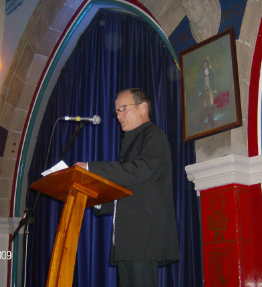 David Hayman did the honours and gave a recital of Hugh MacDiarmid's famous "Immortal Memory" given in 1959 on the bi-centenary anniversary of Burns` birth. On introducing Davy, the Master of Ceremonies commented that he is a man that Burns would have been proud to meet quoting a "A man's a man the world o'r a mans a man for a` that". This was a reference to David's humanitarian work in Afghanistan with his charity Spirit Aid*. Before giving his recital, Davy in turn thanked Colin Beattie, of the Oran Mor, for all his help and support for "Spirit Aid".
At our table we were all very proud of David's "braw" recital which ended with us all charging our glasses and being upstanding to drink a toast to the Immortal Memory of Robert Burns!
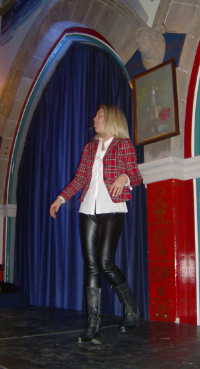
The evening was rounded off by one of Ayr`s "bonnie lassies", Karen Dunbar, who gave a very demonstrative and full recital of "Tam O'Shanter" which had us all enthralled. Even those overseas visitors who did not have a grasp of the Ayrshire dialect could understand the story! A fine way to end the evening!
In between all of this entertainment we were treated to a beautiful meal. (although I did opt for the vegetarian haggis). The wine flowed and the company was excellent, we had such good fun. Thank you Alice and Davy.
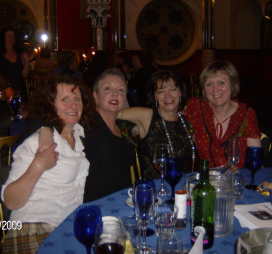
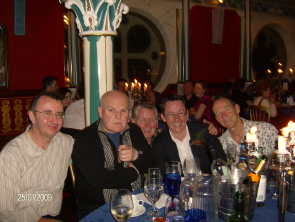
As a wee last note, there was lots of star spotting to do that night. At our table alone we had, of course, the very distinguished actor, David Hayman; Norman O'Leary, painter (see his paintings at the West End Auctions in Whiteinch); Tommy Gormley, film director (1st Assistant). Actually, come to think of it, all of us round the table were stars in our own wee ways!
Other stars spotted included Robbie Coltrane, Barbara Rafferty, Peter McDougall, and Libby McArthur.
*Spirit Aid, founded in 2001 by David Hayman and friends, is a completely volunteer organisation set up to support children and young people around the world by running humanitarian projects in places like Kosovo, Guinea Bissau, Afghanistan, Sri Lanka, South Africa and Scotland. Our work will continue to grow at home and abroad helping young people towards a better, healthier and happier life. A volunteer-based organisation, Spirit Aid commits 90% of all donations to humanitarian aid- 10% to administration. Spirit Aid relies solely on the goodwill and donations of its supporters. www.spiritaid.org
Some photographs from the night:
Weblog archive
Trees for Life Adventure, April 2008.: Friday 25 Apr 2008
Go Bike!: Monday 17 Mar 2008
Trees for Life - Volunteer Work Week: Thursday 17 Jan 2008
The Arran Ferry: Tuesday 5 Jun 2007
Issi's adventures March 2007: Saturday 10 Mar 2007
A Case of Mistaken Identity: Sunday 28 Jan 2007
My trip for a Hot Stone Massage ? Nov 06: Tuesday 14 Nov 2006
[ RSS .91 RSS 2 ]